To understand modern spearfishing in Guåhan, you have to look back nearly 4,000 years — to a people who didn't just fish the ocean. They owned it.
CategoryLineage
PublishedJune 2026
Read Time7 min
LocationGuam, Micronesia
To understand the spirit of modern spearfishing in Guåhan, you have to look past the modern reels, the carbon fiber fins, and the spearguns of today. You have to look back to the very beginning — back to a time when survival meant conquering the deep blue with nothing but raw instinct, handcrafted tools, and an unparalleled understanding of the ocean.
On Guam, fishing isn't just a weekend hobby. It is an unbroken lineage of ocean mastery that spans millennia, making our people some of the greatest watermen the world has ever seen.
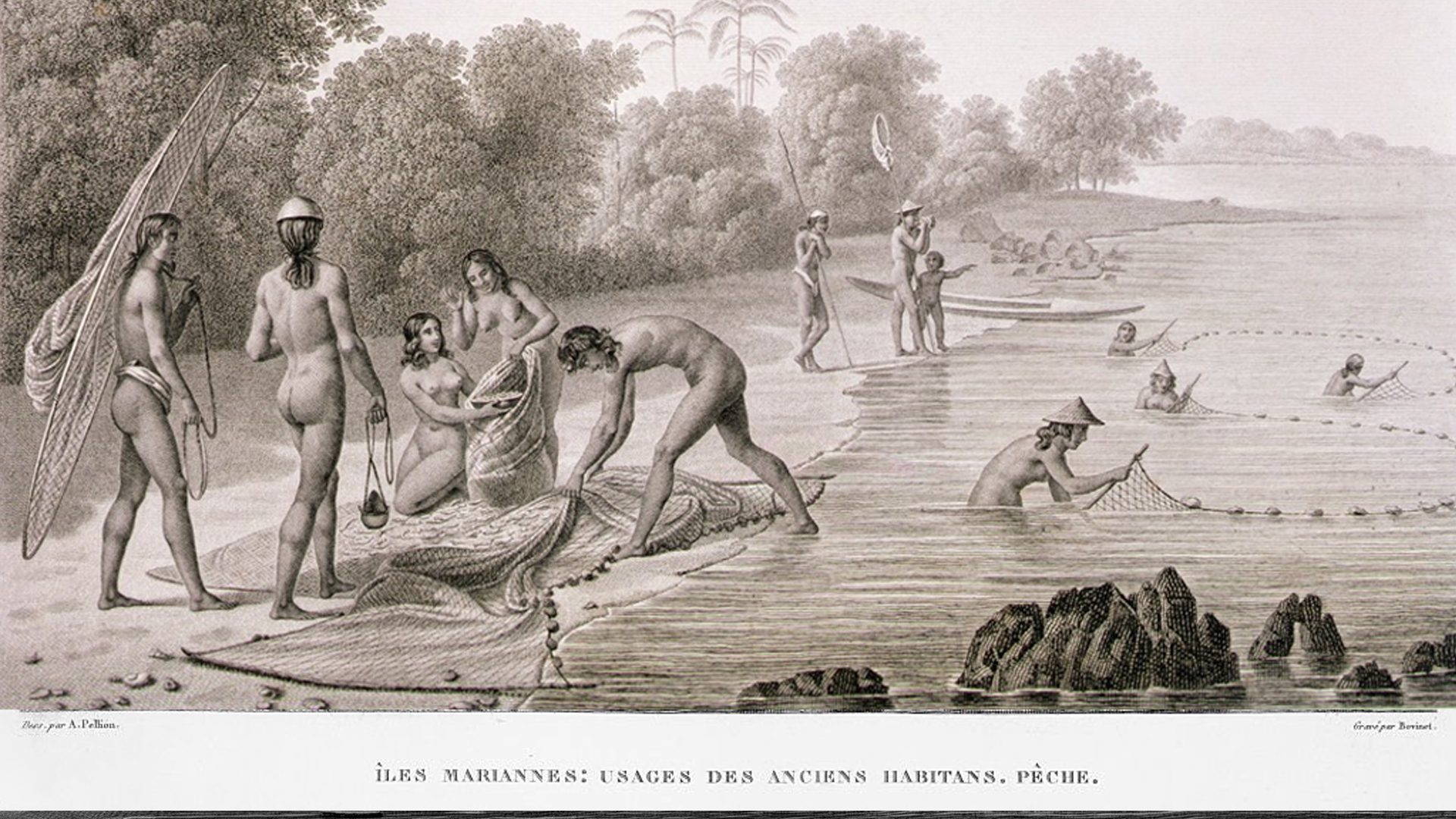
Îles Mariannes: Usages des Anciens Habitans. Pêche."Mariana Islands: Customs of the Ancient Inhabitants. Fishing."Dessiné par A. Pellion · Gravé par Bovinet · c. 1817–1822Alphonse Pellion was a midshipman and the official artist aboard the French ship L'Uranie, commanded by Louis de Freycinet. The expedition spent several months on Guam in 1819 documenting Chamorro culture, language, and daily life. This sketch was drawn from descriptions of how the ancient inhabitants fished before European contact altered their traditional way of living — making it one of the earliest Western records of pre-contact Chamorro fishing practice in these islands.
Watermen Pioneers
More than 4,000 years ago — and by some archaeological records, as far back as 5,000 to 6,000 years — the Chamorro people of Guåhan were already here. So long, in fact, that researchers have identified a distinct Chamorro genetic signature, a DNA lineage developed over thousands of years of living on and from this island. The ocean wasn't discovered by the Chamorro — it was inherited, generation after generation, until it became inseparable from who we are.
From the moment our ancestors arrived, the ocean wasn't just a resource — it was the foundation of everything. Our entire civilization was built around it. The Chamorro people developed an ocean culture so deep and so refined over millennia that by the time outside observers ever encountered them, what they witnessed seemed almost impossible.
Ocean Harvest
Before the arrival of Europeans, the concept of a meat-heavy diet simply didn't exist on Guam. There were no cows, pigs, goats, or chickens roaming the hills. The ancient Chamorros looked to two main sources for sustenance: the fertile soil for fruits and root crops, and the massive, untamed Pacific Ocean for protein.
They lived almost entirely on what they could harvest from the water. While the reef provided daily sustenance, the ancient fishermen were not content staying in the shallows. They were masters of the deep-sea catch.
Using highly advanced, incredibly fast sailing canoes called proas, Chamorro fishermen ventured far beyond the safety of the reef into the drop-offs and open ocean. They successfully targeted elite pelagic game fish — fast, powerful predators like wahoo (sollu) and mahi-mahi (botague). To pull these fish from the deep ocean using ancient materials required an elite understanding of fish behavior, weather patterns, and ocean currents.
"No better seamen or divers have ever been known to exist."
— Fray Juan Pobre, Spanish Franciscan Friar, 1602
When Western explorers finally stumbled upon these islands, they were completely unprepared for the level of maritime genius they encountered. The Spanish had large, heavy galleons — but they watched in awe as the nimble Chamorro proas literally sailed circles around them.
The historical accounts from early visitors paint a vivid picture of a people who were more at home in the water than on land. In 1602, a Spanish Franciscan friar named Fray Juan Pobre lived among the Chamorro people and documented their daily lives. He was utterly blown away by their physical prowess and connection to the ocean.
The Jesuit missionary Father Diego Luis de San Vitores and the Franciscan friar Juan Pobre de Zamora both documented something that stunned them: Chamorro mothers brought their babies into the ocean reefs almost from birth. Children learned to swim and dive around the same time they learned to walk. Europeans recorded this with a kind of disbelief, noting that the Chamorro possessed an almost "amphibious" nature — appearing as naturally at home in open ocean as they were on land.
The physical capabilities of Chamorro divers left Spanish observers at a loss for words. They dove to depths that seemed impossible. They opened their eyes underwater in the clear, salty reef water and tracked prey with precision. Their breath control — calm, deliberate, trained from infancy — let them stay under for periods that struck European sailors as inhuman. In 1565, Esteban Rodríguez, the pilot aboard the Legazpi expedition, wrote plainly in his ship's log that the Chamorro were so skilled in the water that they were "said to be able to catch fish with their bare hands."
Maño'cho' — fishing by hand at low tide — was practiced across the reef flats, reading the water and moving with patience. Lalagu was practiced primarily by women: reaching into reef crevices and underwater caves, feeling in the dark for fish or shellfish, then tickling them gently before seizing them with a single pull. The Spanish logs read less like exaggeration and more like genuine awe of a people completely in harmony with the sea.
Western explorers also watched in shock as Chamorro divers interacted with the ocean's apex predators. While Europeans feared the deep, ancient Chamorros would dive down to tease and out-maneuver sharks — treating the ocean's fiercest creatures with the casual confidence of someone walking through their own backyard. The accounts speak for themselves.
Masters of Marine Engineering
The ancient Chamorros didn't rely on brute strength and courage alone. They were masterful marine engineers. One of their most ingenious inventions was the poi'o — a specialized deep-water chumming device made from a carefully carved, heavy hemispherical limestone sinker attached to a coconut shell.
Using long, hand-woven fiber lines, fishermen would lower the poi'o packed with mashed coconut meat from their canoes into the deep blue outside the reef. Over a period of weeks, they would patiently feed the fish at depth, gradually shortening the line day by day to lure massive schools of deep-sea pelagic fish right up to the surface where they could be harvested. It was a display of incredible patience, strategy, and a perfect understanding of fish behavior.
The Bloodline in Every Speargun
This is the lineage we carry forward.
When you pick up a speargun on Guam, you aren't just participating in a sport — you are stepping into a multi-thousand-year-old legacy. You are walking the same reefs and looking out at the same deep-blue horizons that the greatest fishermen in human history mastered nearly four millennia ago.
The gear has evolved from bone hooks and carved spears to precision-engineered spearguns, but the fundamental truth remains the same: the ocean demands respect, skill, and an undeniable strength of spirit.
We build tools for the modern waterman, but our inspiration comes straight from the ancestors. We are proud of where we come from, proud of the waters we fish, and honored to keep the spirit of the world's greatest watermen alive. That same lineage shows up at the table too — see how the catch becomes Guam seafood recipes passed down the same way the fishing was.