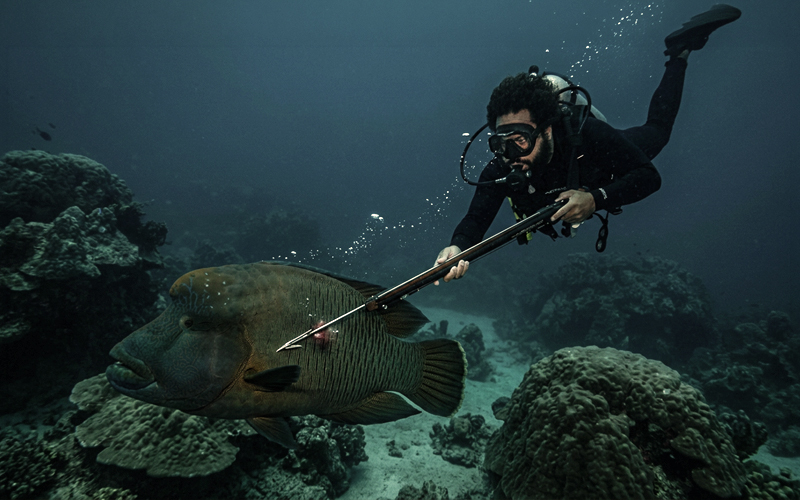
Across the Pacific, traditional breath-hold free diving has long been the gold standard for sustainable spearfishing. For decades, however, Guam permitted scuba spearfishing — a method that allowed fishers to remain submerged at deep reef depths for hours. Because vulnerable fish species had nowhere left to hide, this practice significantly altered local marine ecosystems.
That changed in March 2020, when Guam implemented a complete ban on the practice. The following details outline the historical context, the legislative timeline, and the factual status of Guam's reef recovery.
When Did the Ban Begin?
The restriction officially went into effect on March 26, 2020.
Governor Lou Leon Guerrero signed Bill 53-35 (introduced by Senator Sabina Perez) into law. The statute made it completely unlawful to harvest fish with a spear while utilizing scuba equipment in Guam's waters. Furthermore, the law established that possessing both scuba gear and speared fish or spearguns on the same vessel constitutes prima facie evidence of a regulatory violation.
Why Was Guam Among the Last to Implement a Ban?
Guam was one of the final jurisdictions in the Pacific region to outlaw scuba fishing. By the time Bill 53-35 passed in 2020, more than 63 countries and jurisdictions — including the neighboring Commonwealth of the Northern Mariana Islands (CNMI) and almost every other major Pacific island nation — had already banned the practice years prior.
The historical delay was driven by two distinct factors:
- Prolonged Legislative Debate: Efforts to pass a ban spanned more than a decade. Similar bills introduced in the 30th and 31st Guam Legislatures repeatedly failed to pass due to intense opposition from commercial fish vendors and local harvest groups, who argued that regulators should focus on land-based pollution and erosion rather than fishing gear.
- The 2015 Global Biomass Study: A turning point occurred following a global meta-analysis published by MacNeil et al. (2015), which examined data from 832 coral reefs across 64 locations worldwide. The study concluded that out of hundreds of reefs, only two geographic areas had reef fish biomass depleted enough to indicate a total fisheries collapse: Papua New Guinea and Guam. This data provided the empirical baseline that local lawmakers needed to advance the legislation.
Target Species Impact
Data compiled by the Guam Department of Agriculture's Division of Aquatic and Wildlife Resources (DAWR) highlighted how efficiently scuba fishing targeted vulnerable deep-water species. Prior to the 2020 ban:
Because these slow-growing reef species depend on deeper waters to reach maturity before returning to replenish shallow-water populations, targeting them at depth severely disrupted their reproductive lifecycles.
The Current Regulatory Framework: Size and Catch Numbers
A distinct element of Guam's maritime policy is its baseline reef regulations. Outside of Guam's five designated Marine Preserves (Pati Point, Tumon Bay, Piti Bomb Holes, Sasa Bay, and Achang Reef Flat), the following facts apply to nearshore reef fishing:
- There are no fish size limits.
- There are no bag limits (restrictions on the total number of fish caught).
- There are no general recreational license requirements for residents or visitors.
The Fact: While most coastal U.S. states and territories enforce strict catch quotas and size minimums, Guam's open-access system outside of its preserves made the scuba ban one of the few legal checkpoints protecting deep-water populations from rapid depletion. Outside the five preserves, it's still close to the wild west — no size limits, no bag limits, no license required. The ban closed one door, while the rest of the house stays wide open.
Factual Status of Fish Stock Recovery
Marine ecosystems recover on multi-decadal timelines. Long-term data and fisher observations collected prior to the ban showed a stark downward trend in fish sizes and availability over a 10-to-20-year span. Since the 2020 ban took effect, data from local marine biologists indicates a developing timeline:
- Increased Sightings: Field biologists and local divers have documented a steady increase in anecdotal sightings, photos, and videos of juvenile and adult Atuhong (Humphead Parrotfish) in reef zones where they were previously completely absent.
- Recovery Timelines: Because the baseline fish biomass was exceptionally low prior to 2020, scientific recovery requires significant time. Global data from the 2015 reef study indicates that heavily depleted reefs can take up to 60 years to fully recover their original biomass functions.
- Forthcoming Management Plans: To address the lack of size and bag regulations, the Guam Department of Agriculture and the University of Guam (UOG) Sea Grant have been drafting a comprehensive Guam Fisheries Management Plan. This framework aims to establish sustainable, community-backed baseline quotas. Concurrently, in federal waters (3 to 200 miles offshore), NOAA Fisheries maintains strict Annual Catch Limits (ACLs) to manage deep-sea bottomfish stocks.
The Bottom Line
Guam's 2020 ban closed a significant loophole in local marine conservation. While the island's reefs require many more years to achieve full biological recovery, removing scuba gear from the equation has successfully halted the primary driver of deep-water reef fish depletion.