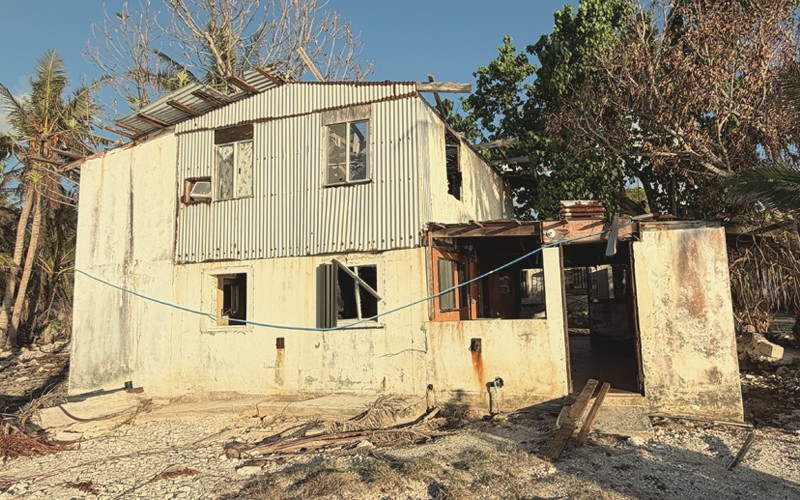
That house is where my spearfishing journey started. My uncle Jerry taught me how to read the water from that beach — where the current bends around the reef, where the fish hold at depth, how to be still enough underwater that you stop being a threat. Most of what I know about diving, I learned there.
He's gone now. The family had long since moved on. And the house — weathered, salt-worn, sitting a few feet from the water like it always had — was coming down.
Before it was lost for good, I pulled some of the beams.
What Was in the Walls
Old-growth Guam mahogany. The kind that was used to build homes here before the modern era — dense, dark, with a grain that took decades to develop. You can't buy it. You can't order it. It exists in houses like Jerry's, and when those houses come down, it's gone.
The color is deeper than anything plantation-grown. The grain is tighter. You can feel the difference the moment you run a plane across it — there's a resistance and a smoothness at the same time, like the wood knows what it's doing.
What the Wood Became
Two guns. That's what came out of those beams — two mid-handle spearguns shaped from the same mahogany that held that house together for decades, a few meters from the water where I first learned to dive.
I don't know how to explain what it felt like to shape them. It wasn't just woodworking. It was something closer to finishing a conversation that started a long time ago on that beach.
The wood became two guns. Built for memory, shaped by hand, and carrying something no teak blank ever could. One of them is still with me. The other went to someone who understands what they're holding.