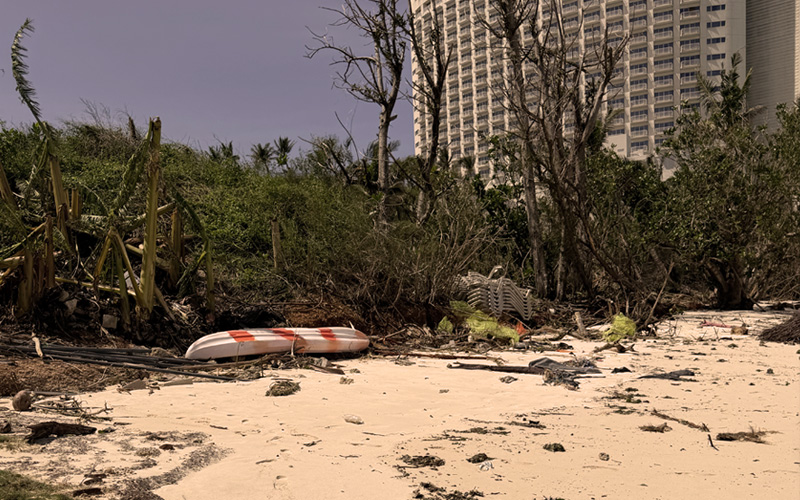
The wind has finally stopped howling and the Typhoon Warnings have been canceled, but the island is far from quiet. While local surfers are already loading up truck beds and rushing out to catch the massive post-storm swell, the rest of the island is entering survival mode. Roads are jamming up with miles-long lines at the few open gas stations, fast-food drive-thrus are wrapped around the block, and local markets are packed with everyone hunting down ice. Meanwhile, the parking lots at local hardware stores are completely gridlocked with people scrambling to grab generators, chainsaws, and repair tools to patch up the damage.
As we look past the chaos on the roads and the debris left behind in our yards, our eyes naturally drift out to the ocean.
For the second time in mere months, our islands have taken a massive hit from a Category 5 system. Packing peak winds of 150 to 185 mph right to our doorstep, these back-to-back storms have knocked out major infrastructure, leaving many families without power and running water.
As a community of spearfishers, free divers, and ocean lovers, our lives are tied to the water. When storms like this hit, they don't just reshape the land — they completely alter our daily survival and the underwater world we call home.
1. Who is Responsible for the Clean Up, Power, and Water?
When a typhoon hits, recovery takes a massive, multi-agency effort. Knowing who does what helps us track progress and know where to direct our community efforts. All four agencies post real-time updates on their Facebook pages — follow them now if you haven't already.
Crews are solely focused on assessing downed lines, repairing transformers, and restoring the island-wide power grid — prioritizing critical infrastructure like hospitals first. Follow GPA on Facebook for outage maps and restoration timelines.
Actively deploying backup generators to water wells and reservoirs to restore water pressure. They urge strict water conservation until the system stabilizes. Follow GWA on Facebook for boil-water advisories and restoration updates by district.
Responsible for clearing physical trash, tin roofs, and green waste from roads. Your village mayor's office coordinates local debris drop-off sites — call or check their Facebook page for the schedule in your area.
Monitors temporary dump sites and watches for hazardous runoff — old paint, motor oil, batteries — leaking into our water table or the ocean. Report illegal dumping or visible chemical runoff to GEPA directly.
If we leave plastic trash and debris piled up on the roadsides waiting for a truck, the next heavy rain will wash it straight into our storm drains, onto our beaches, and directly out into the reef. Protecting the reef starts in our own front yards.
2. Coastline Cleanup: What It Actually Looks Like
The title of this article says "Cleaning Our Coasts" — and that's not just a metaphor for what the agencies will handle. As spearfishers and divers, we know these coastlines better than almost anyone. We know which beaches are hardest hit, which channels collect debris, and which stretches of reef take the worst storm surge. That knowledge matters right now.
Here's how to actually help:
Coordinate with your village mayor first. Don't show up on a beach with a truck and no plan. Your village mayor's office has designated drop-off sites for green waste, construction debris, and regular trash — they're different piles and they matter. Mixing them creates problems for DPW. Get the address before you go.
Gear up properly. Heavy gloves are non-negotiable. Storm debris on Guam's coastlines includes corrugated tin roofing, broken glass, splintered lumber, and loose wire. Flip-flops and bare hands on a post-typhoon beach is how people end up in the ER. Long pants, closed shoes, heavy gloves — then go.
Watch for hazardous materials. Batteries, propane tanks, pesticide containers, and motor oil containers get swept into the ocean constantly after typhoons. If you find something you can't safely handle, mark the location and report it to GEPA rather than moving it yourself. Moving the wrong thing can contaminate a wider area.
Photograph what you find on the reef once you're back in the water. When diving conditions return, document debris you spot but can't safely surface — large tin sheets on the reef, cable wrapped around coral heads, anything that needs a coordinated removal. Photo with location note, send it to us or your local dive clubs. That's how a community-driven reef cleanup starts.
3. Safety First: The Realities of the Water Right Now
With the massive rainfall these storms bring, a historic amount of red mud, soil, sewage overflows, and land debris has streamed directly into the ocean. The water looks brown nearshore right now for a reason, and that reason will kill a dive trip — or worse.
The "Brown Water" Infection Hazard. Diving right now carries a massive risk of severe ear, eye, and skin infections. Because wastewater systems are still stabilizing, bacterial counts nearshore are incredibly high. Stay out until the ocean flushes it out.
Hidden Marine Hazards. The water is currently hiding floating logs, tin roofing, sharp construction debris, and broken glass. Hitting a submerged piece of corrugated tin while coming up for air can be fatal.
Unpredictable Currents. Big storms radically alter underwater sandbars and channels. A spot that was a safe exit last month might have a dangerous rip current right now. Scout from shore before you enter — look at the water surface, watch the foam lines, don't assume your regular spot is the same.
How Long Should You Wait?
This is the question everyone is asking right now. There's no single answer, but here's a realistic range based on what normally happens after a major storm system in these waters:
Active debris in the water, peak bacterial counts, surge still shifting the bottom. Do not enter under any circumstances.
Water starting to clear in exposed areas. Do a shore assessment — look, don't dive. Hidden debris still present. Bacterial counts still elevated nearshore.
Conditions potentially safe for experienced divers at exposed, well-flushed sites. After back-to-back Cat 5s, add more time. Scout everything as if you've never dived it before.
After back-to-back Category 5 systems hitting within months of each other, add more time to every phase. The cumulative damage to drainage infrastructure means sewage and sediment loads are significantly higher than a single-storm event. Err later, not sooner.
4. The Science of the "Deep Retreat"
Where do the fish go when 150+ mph winds are whipping the surface? They don't stay in the shallows to get thrown against the coral.
The Barometric Drop. Marine life is intensely sensitive to atmospheric pressure. As the storm approaches and pressure plummets, fish feel this drop through their swim bladders and lateral lines days before landfall. Reef fish like tataga (unicornfish) and guili (rudderfish), along with larger pelagics, begin moving off their shallow feeding grounds well before the first bands hit the island.
The Deep Migration. To escape the violent surge, fish migrate down the reef faces into deeper water — often 100 feet or more. They don't feed much down there. They shelter. It takes up to a week after a storm passes for pressure to fully stabilize and for fish to comfortably return to their shallow feeding grounds.
The fish aren't gone. They're waiting — the same as us.
5. The Post-Storm Window: Why Timing Your Return Matters
Here's the piece most people miss, and it's the real payoff for waiting properly.
When the water finally clears and pressure stabilizes — typically 10 to 14 days post-storm — reef fish don't just return to the shallows. They return hungry. They've been displaced from their regular feeding grounds for over a week, driven deep by the storm, holding position rather than feeding actively. When conditions normalize and they push back up onto the reef flats and ledges, it often triggers an aggressive feeding response.
Experienced spearos on this island know this window. The first clear-water dive after a major typhoon — once you've verified conditions are genuinely safe — can be some of the best hunting of the year. Fish that have been holding deep are now active and feeding hard on the same reef structure you know, which may have shifted or changed, but is still home to them.
The trap is impatience. Going in five days early for murky water, bacterial infections, and hidden debris is not a trade worth making for that window. Wait the full recovery time, scout your entry point on shore first, and go in with a buddy. Then hunt.
The underwater landscape has changed after back-to-back storms of this magnitude. Old coral structures may be gone, sand channels will have shifted, and new debris may have settled into spots you know well. Dive the first post-storm session like it's a new site — slower, shallower, with your eyes open. Save your aggressive hunting for the second trip once you know what's changed.
The Bottom Line
The storm moved fast, but the recovery — both on land and under the blue water — is going to take time. While we wait for the lights and water to get fully restored, let's do our part as spearos to support our village mayors and DPW by clearing our own neighborhoods and coastlines.
Use this downtime to clean your gear, rig fresh bands, and sharpen your tips. When the water finally clears and you head back out, scout carefully. Do not dive alone. Respect the ocean's recovery time.
And let us know what you're seeing once you safely get back out there — changes on the reef, new structures, fish behavior, anything worth passing on to the community. Tag us or DM us on Instagram. That information helps everyone diving these waters.
Stay safe, conserve your water, look out for your village, and we'll see you on the reef soon.