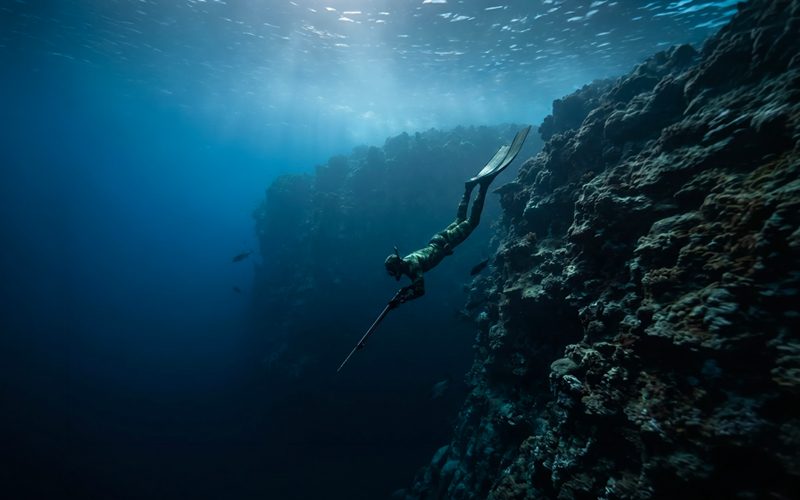
Guam's crystal-clear waters, vibrant coral reefs, and sudden deep-sea drop-offs are a paradise for free divers. But make no mistake: the ocean surrounding our island is as unforgiving as it is beautiful. Because Guam sits isolated in the Western Pacific, we are exposed to massive open-ocean energy. There is no gradual continental shelf here — the reef flats drop instantly into thousands of feet of deep water.
In breath-hold diving, your body is the machine, and your breath is your fuel. If you don't respect the physics of respiration and the unique, volatile nature of Guam's currents, the ocean will win. Whether you're a local spear-fisherman or a visitor here for world-class diving, this is your essential guide to safety, respiration, and surviving Guam's waters.
Why We Do This
None of this is meant to talk anyone out of diving — quite the opposite. Done right, spearfishing is the most selective, lowest-impact way to put fish on a table. There's no net dragging up bycatch, no longline hooking anything that happens to swim past. You see the fish, you take the shot, or you don't. What you bring home is exactly what you meant to bring home — nothing wasted, nothing taken that wasn't needed.
And the dive itself is its own reward. Once you're past the surface and the bubbles settle, there's no phone, no noise, no distraction — just your breath, the current, and the reef below. Spearfishing demands a kind of total presence that's rare to find anywhere else. The same discipline that keeps you alive down there — slow breathing, total calm, reading the water before you move — is what makes the sport feel less like a hunt and more like a practice.
There's also what you get to see down there, which is its own kind of payoff. The creatures, the plant life, the whole world moving below the surface — none of it is for sale, and it doesn't matter who you are or what you have up top, almost no one gets to see it. You're moving through a world that runs every single day completely unseen by everyone living right above it.
On Guam, that practice runs generations deep. Long before it was a hobby, diving the reef was how families fed themselves — knowledge passed down dive after dive, season after season. The divers who last longest out here aren't the ones who took the biggest risks; they're the ones who spent years learning to read a current, anticipate a fish, and know their own body well enough to never push past what it's telling them. That's not luck. That's earned respect — for the ocean, and from it.
Spearfishing isn't a fight with the ocean. Done right, it's a quiet kind of trust.
That respect is exactly why everything below matters. Not to scare you out of the water — but so you're still doing this twenty years from now.
Spearfishing vs. Pure Free Diving
Pure free diving is dangerous on its own — but spearfishing is statistically and practically far more lethal. Pure free diving asks for one thing: total focus on reaching depth, staying relaxed, and ascending along a straight line. Your entire mind tracks one variable — your body's oxygen.
Spearfishing demands far more. You're no longer just monitoring your breath — you're tracking a moving target, fighting horizontal surge, aiming, managing a fired shaft, and wrestling a struggling fish. This creates a lethal phenomenon known as task-fixation. When a diver stalks a high-value prize — a parrotfish or dogtooth tuna over the reef cuts — adrenaline spikes. Heart rate climbs, oxygen burns twice as fast, and because the brain is hyper-focused on the hunt, the diver misses the subtle warning signs of hypoxia. They stay down "just five more seconds" to line up the shot, oblivious to having already crossed the point of no return.
Add the risk of line entanglement — a rigging or reel line wrapping a fin pocket or knife while a powerful fish pulls a diver downward — and it's clear why hunting on a single breath sits at the absolute apex of ocean hazards.
The Stakes Are Real
For comparison: free diving and breath-hold spearfishing are widely ranked among the most dangerous extreme sports in the world — second only to BASE jumping, ahead of skydiving, big-wave surfing, and ice climbing. The split matters, though. Competitive free diving under strict organization rules has a strong safety record. It's unsupervised recreational diving and spearfishing where the numbers get serious.
That single number is why the buddy system isn't optional — it's the highest-leverage thing you can do to stack the odds in your favor. Once you submerge, you're on a biological countdown, so the person watching you matters as much as your own technique.
Skill Isn't a Substitute for Protocol
Advanced skill doesn't make you immune. The ocean doesn't track sponsorships, world records, or lung capacity — only whether protocol was followed. Even some of the most respected names in the sport have been lost, almost always while training or attempting records outside the safety net of tightly controlled competition. It's a reminder that the basics — a buddy, a plan, a limit you don't push — matter more than raw ability.
This isn't a distant statistic for us, either. In March 2023, the Guam fishing community lost one of our own.
-
2023
Captain Dylan Cruz
A friend and fellow waterman, lost spearfishing right here at home. He's part of why this page exists. We miss you, Par — Angels fish forever.
-
2015
Natalia Molchanova
The greatest female free diver of all time, holding 41 world records. Vanished off Ibiza, Spain during a routine dive well within her limits.
-
2017
Stephen Keenan
A legendary professional safety diver and Irish depth record holder, lost at Egypt's Blue Hole while guiding a world champion back to the surface.
A handful of other divers, from world champions to people we knew personally, have been lost under similar circumstances over the years. The lesson isn't about who's skilled enough — it's that no one is exempt from the protocol.
This documentary covers Stephen Keenan's story — the years of training and trust behind his partnership with world champion Alessia Zecchini, and the single moment at Egypt's Blue Hole when a routine safety dive went wrong. It's a clear illustration of how thin the margin for error is at depth: even one of the best safety divers in the world had only seconds to work with. Treat that margin as real every time you're in the water.
The Physiology of Respiration: Managing O₂ and CO₂
Free diving is a mind-and-body game of managing gases. Many divers think the urge to breathe comes from running out of oxygen (O₂) — it actually comes from the buildup of carbon dioxide (CO₂).
The Danger of Hyperventilation
A common, fatal mistake is hyperventilating before a dive — fast, deep breaths. Hyperventilation doesn't add oxygen to your blood; it artificially flushes out CO₂. If you lower CO₂ before diving, you disable your body's natural alarm. You'll feel completely fine right up until oxygen drops below the threshold needed to stay conscious — a Shallow Water Blackout.
The Standard Breathe-Up Protocol
Relaxation phase: breathe slowly and naturally — exhale roughly twice as long as you inhale. The final breath: a deep, relaxed three-stage breath — belly, then chest, then throat — and submerge. Never pack air aggressively.
Know the Reef Pump
Guam's underwater topography is unlike most diving destinations. Shallow barrier reefs drop suddenly into open-ocean depth, with no gradual shelf to ease the transition. When swells break over the reef, the trapped water has to find its way back out — and it does, rushing through reef cuts and channels as a rip current that can exceed 5 miles per hour, faster than any human can swim against.
It's easy to look at the turquoise water at Marbo Cave, Ritidian Point, or Tagachang Beach and see only paradise — and most days, that's exactly what it is. The currents underneath are real, though, and the Guam Department of Public Health and Social Services (DPHSS) Office of Epidemiology and Research puts a number on it: an average of 8–12 lives lost in Guam's waters each year, the majority of them preventable.
Experienced swimmers who underestimated the reef pump, newcomers unfamiliar with Pacific swells, visitors who went out under a High Surf Advisory anyway — that's where almost all of it comes from. Respect the advisory, know the cut, and you've already avoided most of what gets people in trouble out here.
Diving Guam's Currents: What to Do — and What to Avoid
The Essential Pre-Dive Safety Checklist
Before your fins touch the water at Boonie or Gun Beach, run through this strict checklist:
- The 1:1 Buddy Rule — one diver descends while the safety watches from the surface, tracking the diver the entire time and waiting at least 30 seconds after surfacing to rule out a post-surface blackout.
- Weight Check — be neutrally buoyant at 10 meters (33 feet). If you lose consciousness near the surface, your weights should not drag you down — you must float effortlessly at the surface.
- Snorkel Out — remove your snorkel from your mouth on descent. An open snorkel lets water into your lungs if you black out on the way up; keeping it out lets your jaw lock shut via the laryngospasm reflex, buying your buddy time to save you.
- Local Conditions Check — if the water looks churned, brown, or choppy at the reef cuts, cancel the dive. Weather in the middle of the Pacific changes fast.
Want a version of this you can actually check off before you load the truck? Try our interactive gear checklist →
Guam offers some of the most breathtaking underwater vistas on earth — and it rewards the divers who take it seriously. Respiration control, proper weighting, a dedicated safety buddy: none of it is complicated, it just has to be consistent. Do that, and the ocean stops being something to survive and becomes what brought you here in the first place. Know your limits, respect the water, and you'll be back out past the reef line again tomorrow.
Dive safe.
This article is for safety education and awareness only — it is not a substitute for certified free diving or rescue training. Statistics referenced are aggregated from publicly reported sources including DAN, WHO, and various national and regional safety agencies; figures are estimates that vary by reporting period and methodology. Before diving in Guam, also review our Safety & Regulations guide for marine preserve boundaries and reporting contacts.