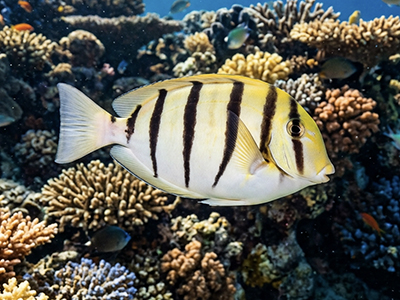
Guam Waters Public Health Ciguatoxin Has No Taste, No Smell Cooking Does Not Neutralize CTX Only 2–10% of Cases Are Reported 60% Rise in Pacific Incidence Since 1973 Gådao · Tagåfi' · Tarakitu · Hugupau Guam Waters Public Health Ciguatoxin Has No Taste, No Smell Cooking Does Not Neutralize CTX Only 2–10% of Cases Are Reported 60% Rise in Pacific Incidence Since 1973 Gådao · Tagåfi' · Tarakitu · Hugupau
Advisory

Guam DPHSS urges the community to be aware of fish poisoning (ciguatera). Cases are significantly underreported across the Marianas. When in doubt, leave it out.

Guam Waters · Public Health

Ciguatera — What Every Guam Fisher Needs to Know

Regional Assessment · Hawaii & Micronesia · Updated 2025

Ciguatera fish poisoning is the most common marine toxin illness on earth — and our reefs are ground zero. It concentrates in the same predatory fish we catch, eat, and share. There's no test, no cure, and the toxin survives cooking. Here's everything you need to know.

500K+
Pacific Islanders
Affected Est. Since 1973
+60%
Rise in Incidence
1973–83 vs 1998–2008
2–10%
Cases Ever
Reported to Health Auth.
74.5%
Fish Tested
Positive, Kiribati 2022
53×
Over Safety
Threshold — Top Grouper
194
Cases per 100K
Pacific Mean, 1998–2008

What Is Ciguatera?

The Source

Ciguatera is caused by ciguatoxins (CTX) produced by a microscopic marine alga called Gambierdiscus toxicus — a dinoflagellate that lives on dead coral and algal mats on tropical reefs. Herbivorous fish eat the algae and absorb the toxin. Carnivorous fish eat those fish, and the toxin concentrates as it moves up the food chain. This is called biomagnification — and it's why larger, older predatory fish carry the most risk.

Why Cooking Doesn't Help

Ciguatoxin is heat-stable. It cannot be destroyed by cooking, freezing, smoking, drying, or marinating. It has no taste, no odor, and does not change how a fish looks or smells. There is currently no commercially available test to detect it in fish at the dock, market, or table level.

Why It's Getting Worse

  • Rising ocean temperatures expand Gambierdiscus habitat and blooms
  • Coral reef bleaching creates more bare algal substrate for the dinoflagellate
  • Typhoon and storm damage disrupts reef ecosystems
  • Coastal development, dredging, and port activity disturb benthic habitat
  • Nutrient runoff from land stimulates toxic algal growth
  • Increased inter-island fish trade spreads risk beyond point of catch

Guam & The Marianas — Ground Zero

Guam sits in one of the most ciguatera-active regions on earth. The CNMI has seen documented increases in ciguatera poisoning from bottom fish. With a culture deeply tied to reef fishing and sharing fish across families and villages, a single contaminated fish can affect an entire household. DPHSS Guam has issued multiple public advisories warning the community about fish poisoning risk.

"An estimated 500,000 Pacific islanders may have suffered from ciguatera in the last 35 years — corresponding to a lifetime prevalence of 25%. It is remarkable that ciguatera has largely been ignored."
Skinner et al., PLoS Neglected Tropical Diseases, 2011

The Numbers Are Rising

Mean annual incidence across Pacific Island Countries & Territories (per 100,000 people). A 60% regional increase was confirmed between 1973–1983 and 1998–2008. The trend is expected to continue.

1973–1983
104
Cases per 100K
Pacific baseline
1989–1992
~150
Cases per 100K
SPEHIS data
1998–2008
194
Cases per 100K
+60% increase
2010–2020
<9
Hawaii avg/yr
(highly underreported)
2022+
CNMI increase
confirmed, rising

On underreporting: Health authorities estimate only 2–10% of ciguatera cases are ever reported. In Hawaii this may be even lower. If only 5% of cases are counted, Guam's real exposure may be dramatically higher than official numbers suggest — especially given how common subsistence reef fishing is across the island.

Reported Annual Incidence by Pacific Territory — 1998 to 2008
Cases per 100,000 people. Guam and Micronesian territories highlighted in dark. Source: Skinner et al. (2011), PLoS NTD.
Then vs. Now — Incidence Comparison 1973–83 vs 1998–2008
Side-by-side change in reported incidence per 100,000 people. Note dramatic rises in Cook Islands, Marshall Islands, Vanuatu. Source: Lewis (1986); Skinner et al. (2011).

Which Fish Carry the Most Toxin?

Ciguatoxin concentrations measured in grouper and snapper from Marakei Island and Kiritimati Island, Republic of Kiribati (2022). These same species are present in Guam waters. Values in pg/g wet weight as P-CTX-1 equivalents. Safety limit: 10 pg/g.

P-CTX-1 (Most Potent)
P-CTX-2
P-CTX-3
Ciguatoxin Concentrations by Species — Kiribati Field Study
Red dashed line = 10 pg/g safety threshold. All species shown are present in Guam reef systems. Source: Yoshiaki U et al. (2022), PMC8952361.

Key finding: 74.5% of fish from Marakei Island and 61.5% from Kiritimati Island exceeded safe CTX levels. The most toxic individual — a white-spotted grouper (Epinephelus coeruleopunctatus) — registered 53× the safety threshold. Coral grouper (Cephalopholis miniata) reached 28× the limit. These species are all present in Guam waters.

Chamorro Names & Risk Reference

Chamorro fish names sourced from Kerr (1990), Chamorro Fish Names, Micronesica 23(2) — the authoritative academic reference compiled from Guam, Rota, and Saipan fishermen interviews. indicates confirmed or likely presence in Guam waters.
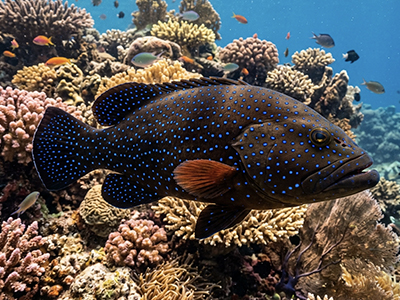
Cephalopholis argus — Guam spearfishing
Cephalopholis argus
Gådao Måslos
Very High
"Gådao" = grouper · "Måslos" = blue-spotted
Peacock Grouper / Blue-spotted Grouper
Cephalopholis argus
Confirmed Guam
Most commonly implicated species in Hawaii ciguatera cases. Abundant on Guam reefs. Apex predator — highest toxin accumulation potential.
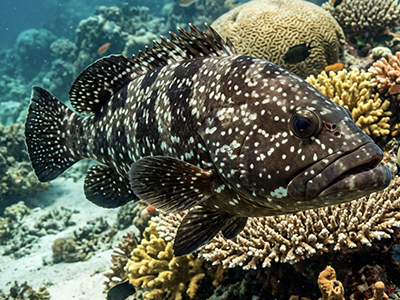
Epinephelus coeruleopunctatus — Guam spearfishing
Epinephelus coeruleopunctatus
Gådao
Very High
General grouper · spotted variants = "Gådao Matingon"
White-Spotted Grouper
Epinephelus coeruleopunctatus
Confirmed Guam
53× the safety threshold detected in a Kiribati study — the highest individual reading on record. Avoid all large specimens.
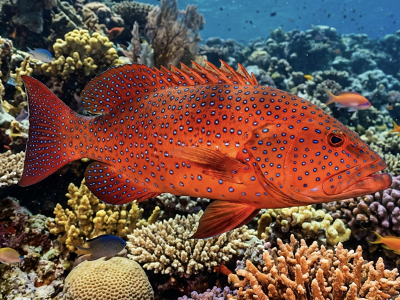
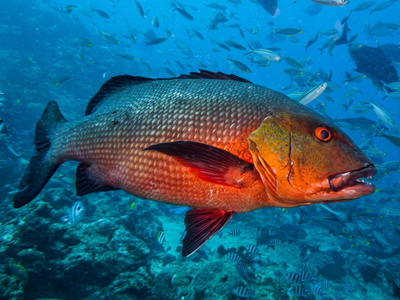
Cephalopholis miniata — Guam spearfishing
Cephalopholis miniata
Gådao
Very High
"Gådao Agaga" · coral-red grouper
Coral Grouper / Coral Hind
Cephalopholis miniata
Confirmed Guam
28× safety limit at Kiritimati. Distinctive orange-red with blue spots. Vivid coloring does not mean safe — this is a high-risk species.
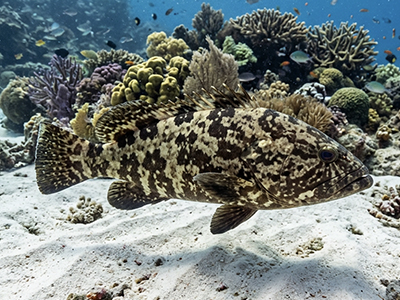
Epinephelus polyphekadion — Guam spearfishing
Epinephelus polyphekadion
Gådao Matingon
High
"Spotted grouper" · mottled brown patterning
Camouflage Grouper
Epinephelus polyphekadion
Confirmed Guam
High total CTX load confirmed in Kiribati study. Common on Micronesian patch reefs and lagoon walls. Frequently caught by spearfishers.
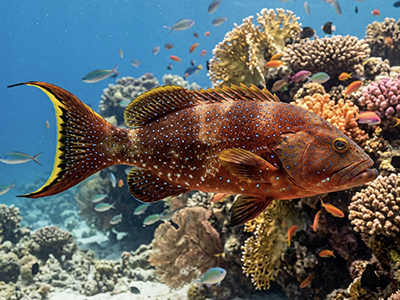
Variola louti — Guam spearfishing
Variola louti
Gådao
High
Kerr (1990) · DeLeon (1965) · "lyretail trout"
Yellow-edged Lyretail / Lyretail Grouper
Variola louti
Confirmed Guam
Confirmed ciguatoxic. Banned from sale in Mauritius when over 1.5 kg. Distinctive crescent tail with bright yellow margins. Common on outer reef slopes.
Lutjanus bohar — Guam spearfishing
Lutjanus bohar
Tagåfi'
High
DeLeon (1965) · multiple Guam fishermen records
Bohar Snapper / Two-Spot Red Snapper
Lutjanus bohar
Confirmed Guam
One of the most notorious ciguatera vectors across the entire Indo-Pacific. High CTX load confirmed across multiple studies. Highly prized table fish — exercise strong caution.
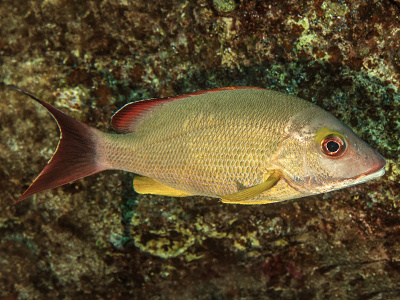
Lutjanus gibbus — Guam spearfishing
Lutjanus gibbus
Fafa'et
High
Also applied to bigeyes · "the salty one"
Humpback Snapper / Paddletail
Lutjanus gibbus
Confirmed Guam
Recorded in Chamorro fishermen interviews for Guam (Kerr 1990). Elevated CTX at Kiritimati. Distinctive hump profile behind the head in large adults.
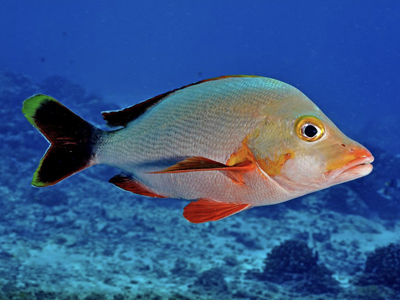
Lutjanus fulvus — Guam spearfishing
Lutjanus fulvus
Buha' Kaka'ka'
Med-High
Named for the sound the fish makes · Kerr (1990)
Blacktail Snapper / Flame-Tailed Snapper
Lutjanus fulvus
Confirmed Guam
High total CTX at Kiritimati Island. Confirmed in Guam by Chamorro fishermen. Recognizable by black caudal fin with red margin.
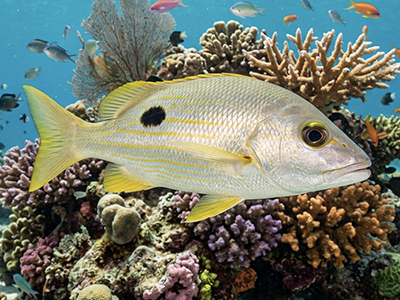
Lutjanus monostigma — Guam spearfishing
Lutjanus monostigma
Buhan Pintu
Med-High
Kerr (1990) · also "Kaka'ka'" in some Guam records
One-Spot Snapper / Moses Snapper
Lutjanus monostigma
Confirmed Guam
Confirmed ciguatoxic — particularly in Tuvalu (IUCN). Single black spot below dorsal fin, more visible in juveniles. Common in Guam and N. Marianas.
Caranx melampygus — Guam spearfishing
Caranx melampygus
Tarakitu
Medium
Spanish-derived · large jacks (Carangidae)
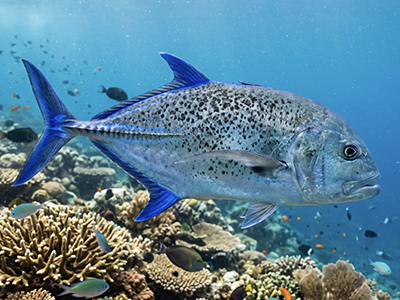
Bluefin Trevally
Caranx melampygus
Confirmed Guam
Predatory jack; toxin accumulates with age and size. Common on Guam reef flats and channel edges. Brilliant electric-blue fins make it unmistakable underwater.
Caranx ignobilis — Guam spearfishing
Caranx ignobilis
Mamulan
High
Largest of the Carangidae jacks on Guam reefs
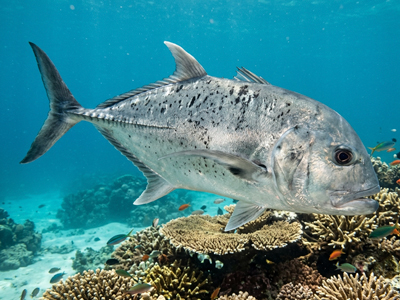
Giant Trevally / GT
Caranx ignobilis
Confirmed Guam
Apex predator jack widely flagged as a ciguatera risk species across the Pacific — large individuals carry the highest toxin loads. Some Pacific fishing tournaments stopped weighing big specimens because they couldn't be eaten afterward.
Acanthurus xanthopterus — Guam spearfishing
Acanthurus xanthopterus
Hugupau Donkolo
Medium
"Hugupau" = surgeonfish · "donkolo" = yellowfin variant
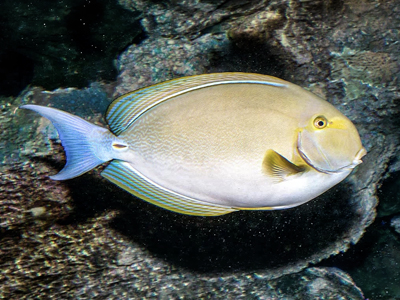
Yellowfin Surgeonfish
Acanthurus xanthopterus
Confirmed Guam
Linked to ciguatera cases in Hawaii. Herbivore but accumulates toxin from reef algae. Risk greatest in large, older specimens from degraded reefs.
Naso unicornis — Guam spearfishing
Naso unicornis
Tataga'
Lower
"One who cuts" · razor-edged caudal spines
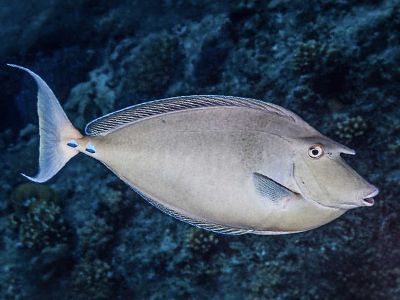
Bluespine Unicornfish
Naso unicornis
Confirmed Guam
Herbivorous; generally lower toxin load. Risk increases in larger, older fish near impacted reefs. Popular in Guam subsistence fisheries.
Acanthurus triostegus — Guam spearfishing
Acanthurus triostegus
Kichu
Lower
Small, striped surgeonfish — distinct from "Hugupau," the larger surgeonfish
Convict Tang / Striped Surgeonfish
Acanthurus triostegus
Confirmed Guam
Herbivorous; lower risk overall. Widely consumed in Guam. Exercise caution near degraded or bleached reef areas where Gambierdiscus blooms are more likely.

Chamorro name sources: Kerr AM (1990). Chamorro Fish Names. Micronesica 23(2): 93–118. Compiled through direct interviews with Chamorro fishermen from Guam, Rota, and Saipan. University of Guam. Names confirmed with DeLeon (1965), Kami et al. (1968), and Topping et al. (1975).

New entries: Lutjanus monostigma (Buhan Pintu / One-Spot Snapper) — confirmed ciguatoxic per IUCN Red List assessment; present in Guam and N. Marianas. Variola louti (Gådao / Yellow-edged Lyretail) — confirmed ciguatoxic; banned from sale in Mauritius when ≥1.5 kg.

Recognizing Ciguatera

Symptoms appear within 1–24 hours of eating contaminated fish. The hallmark is temperature reversal — cold things feel burning hot. Because symptoms overlap with other illnesses, ciguatera is frequently misdiagnosed.

Neurological · Hallmark

Temperature Reversal & Nerve Pain

  • Cold objects feel burning hot
  • Tingling / numbness — hands, feet, lips, tongue
  • Intense itching (pruritus)
  • Tooth pain, metallic or electric taste
  • Dizziness, blurred vision, headache
  • Muscle weakness and joint pain
Gastrointestinal · First Onset

Nausea, Vomiting & Cramps

  • Nausea and vomiting (often first)
  • Watery diarrhea
  • Abdominal cramping
  • Onset typically 1–6 hours after eating
  • Can mimic food poisoning or stomach flu
Cardiovascular · Severe Cases

Heart Rate & Blood Pressure

  • Low blood pressure (hypotension)
  • Slow heart rate (bradycardia)
  • Irregular heartbeat
  • More common in elderly or high-dose exposure
  • Seek emergency care immediately
Chronic · Weeks to Months

Prolonged Neurological Effects

  • Neurological symptoms may persist for months
  • Fatigue, depression, insomnia
  • Worsened by alcohol, nuts, chicken, pork
  • Repeat exposure increases severity
  • No approved cure or antidote exists

If you suspect ciguatera: Go to the ER and tell your doctor you ate reef fish. Treatment is supportive — IV fluids, symptom management. During recovery avoid alcohol, nuts, and fish, which may trigger relapse. Report all suspected cases to Guam DPHSS.

How to Protect Yourself

There is no way to detect ciguatoxin by sight, smell, or taste. Cooking, freezing, and smoking do nothing. Avoidance is the only effective protection.

01

Avoid Large Predatory Reef Fish

Toxin concentrates up the food chain. Larger, older fish carry the most risk. Grouper (Gådao), large snapper (Tagåfi'), and amberjack over 6 lbs are the highest concern. The bigger the fish, the more toxin it may have accumulated over its lifetime.

02

Never Eat the Head, Liver, or Roe

Ciguatoxin concentrates most heavily in the organs — especially the head, liver, and eggs — even when the flesh carries a lower level. Never eat these parts of any large predatory reef fish, especially Gådao or Tagåfi'.

03

Know Where Your Fish Came From

Fish caught near recently bleached reefs, areas of storm damage, or known hot spots carry greater risk. Ask where the fish was caught. Fish traded in from other islands can also carry risk — the Bohar Snapper (Tagåfi') is known to move toxin across the region.

04

Choose Pelagic Fish Instead

Open-ocean fish — mahi-mahi (mahimahi), yellowfin tuna (kachu'), wahoo (uahu), and skipjack — are far lower risk because they don't feed on reef fish. Small herbivorous reef fish also carry far less toxin than large predators.

05

Check Local Advisories

Guam DPHSS and CNMI CHCC issue fish advisories. Check before eating any unfamiliar reef species or fish gifted from a new location. When in doubt — leave it out. Report cases at dphss.guam.gov.

06

Cooking Does Not Help

Ciguatoxin survives all food preparation — boiling, frying, grilling, smoking, marinating, and freezing. There is no visual, smell, or taste test. Until an affordable real-time detection tool exists, avoidance of high-risk species is your only defense.

Scientific Sources
  1. Skinner MP, Brewer TD, Johnstone R, Fleming LE, Lewis RJ (2011). Ciguatera Fish Poisoning in the Pacific Islands (1998–2008). PLoS Negl Trop Dis 5(12): e1416. doi:10.1371/journal.pntd.0001416
  2. Yoshiaki U et al. (2022). The Occurrence, Distribution, and Toxicity of High-Risk Ciguatera Fish Species in Kiritimati Island and Marakei Island, Republic of Kiribati. PMC8952361.
  3. Friedman MA, Fleming LE et al. (2008). Ciguatera Fish Poisoning: Treatment, Prevention and Management. Marine Drugs 6: 456–479.
  4. Lewis ND (1986). Epidemiology and Impact of Ciguatera in the Pacific. Marine Fisheries Review 48: 6–13.
  5. Kerr AM (1990). Chamorro Fish Names. Micronesica 23(2): 93–118. University of Guam.
  6. Hawaii Sea Grant Pacific Ciguatera Network — seagrant.soest.hawaii.edu
Public Health Resources
  1. Guam DPHSS — Fish Poisoning Advisory (2020). dphss.guam.gov
  2. CNMI CHCC — Increase in Ciguatera Fish Poisoning. Post Guam / Pacific News (2021).
  3. Pacific Island Climate Adaptation Science Center — How will changing reefscapes affect ciguatera in Hawaiʻi? pi-casc.soest.hawaii.edu
  4. HPU Research on Marine Toxin Pathways in Hawaiʻi Reef Fish (2025). Maui Now
  5. University of Guam Marine Lab — Fish Resources of Guam. Amesbury & Myers (1982).

Disclaimer: This document is for public education purposes. It does not constitute medical advice. If you suspect ciguatera poisoning seek emergency medical care immediately and report to Guam DPHSS.